
Ultimissime su Colombo, non il tenente, ma proprio Cristoforo, quello che si dice abbia scoperto l’America.
Dopo le ultime mirabolanti ricerche di una illustre storica spagnola, che avrebbero dimostrato come lo scopritore sarebbe nato a Sanluri (a proposito, dov’è Sanluri?) e avrebbe appreso le sue profonde conoscenze astronomiche e nautiche vagando per il Campidano, ecco scaturire, dai mitici archivi mercantili genovesi, l’ultima e definitiva verità.
È noto che i genovesi sono quanto mai riservati, specie quando ci sono di mezzo le palanche, e che in passato essi hanno raggiunto tutte le parti del mondo possibili e immaginabili, senza mai darne notizia ad alcuno, per accumulare palanche in santa pace senza il timore della concorrenza. Centinaia, forse migliaia, di genovesi compirono viaggi come quello di Marco Polo, ma si guardarono bene da spifferare quello che avevano visto. In compenso, dopo aver catturato Marco Polo, gli misero come compagno di cella un certo Rustichello da Pisa, leggermente grafomane, per spremergli tutte le informazioni che potevano.
In America, i genovesi ci andavano a commerciare e a fare palanche molto prima della Scoperta. Infatti, quando i primi vichinghi toccarono le rive del nuovo mondo, si videro offrire dagli indigeni un piatto di trenette col pesto. Dai documenti appare inoppugnabile il fatto che Cristoforo Colombo non fu che uno dei molti genovesi nati in America. I suoi genitori, infatti, avevano lo scagno a Columbus Circle. Stufi di averlo sempre tra i piedi, un giorno gli dissero:
— Basta fare il bamboccione per casa. Vattene in giro per il mondo a guadagnare palanche per conto tuo. —
Invece di “buscar el poniente por el levante”, il giovane Cristoforo andò “buscando el levante por el poniente”. Infatti, dall’America, andò a scoprire la Spagna. Qui giunto, si cambiò il nome in Cristobal, per il gran numero di balle che si mise a raccontare. A forza di balle, Cristoforo riuscì a persuadere i reali di Spagna che andando a ponente invece che a levante c’era da fare una grandiosa scoperta.
In realtà, da buon genovese, aveva solo scoperto il modo di tornare a casa gratis.
Siamo orgogliosi dei risultati di queste profonde ricerche storiche, grazie alle quali la storiografia italiana delle esplorazioni geografiche si eleva allo stesso eccelso livello dell’analoga storiografia spagnola.
Categoria: Ridicularia (Pagina 51 di 52)
GROTTESCA BANDA DI BURATTINI,
CON SUPREMO SPREZZO DEL RIDICOLO,
CREDEVA DI APRIRE UNA NUOVA ERA,
E INAUGURAVA L’ETÀ DEL VESPASIANO.
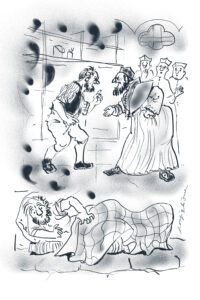
Era finalmente spuntato il gran giorno, il giorno del giudizio papale per il grande progetto dell’affresco del Giudizio universale nella Cappella Sistina. Clemente VII, al secolo Giulio De’ Medici, rivolse al grande artista uno sguardo stanco, in cui si avvertiva il peso delle innumerevoli delusioni e sconfitte subite, non senza una buona parte di colpa da parte dello stesso Papa. Il sacco di Roma e i sette mesi di prigionia in Castel Sant’Angelo, l’umiliazione della fuga travestito da venditore ambulante, le beffe di Pasquino, non erano ricordi facili da dimenticare. Ma come committente d’arte appariva sicuro di sé, forte del potere delle chiavi, perché a lui competeva guidare l’artista nella difficile impresa di esprimere i misteri della Fede. E così, con grave cipiglio, apostrofò subito Michelangelo Buonarroti:
Uno studio megagalattico, con arcate dorate e un enorme numero di libri dall’aspetto incombente e minaccioso.
Personaggi:
Il SUPERACCADEMICO;
VOCE maschile al telefono (si sente grazie ad un altoparlante incorporato nell’apparecchio).
SUPERACCADEMICO (intento a meditare sulle sudate carte) — Adunque, quale sarà il principio incomputabile, che manifestasi attraverso la metafora gentile del vero? Quale la pregnanza trascendente ingenita nel …….
(Squilla il telefono.)
SUPERACCADEMICO — ……. cavolo ……. chi osa turbare le mie trascendentali meditazioni? (solleva la cornetta) Pronto.
VOCE — Mi chiamo Lampadio Illuminoni. Parlo col professor Federico Maria De Bellis?
AFORISMI LETTERARI
Chi non sa fare un aforisma farebbe bene a rinunciare a scrivere.
Il libro più bello è quello che non si ha il coraggio di scrivere perché rivelerebbe troppo di noi stessi.
Il segreto per vincere un grande premio letterario? Loggia-letto. Ossia: appartenere alla stessa loggia massonica del grande editore e andare a letto col presidente della giuria. Ecco perché è meglio non vincere.
Si deve scrivere anzitutto per il proprio piacere. Se poi si vendono tanti libri e arride il successo da parte di pubblico e critica, bene. Se no, tanto peggio per il pubblico e la critica.
“O bimbi, o guardate he mi so’ stufaho. E m’avete hucinato in tutte le salse. E m’avete fatto sorgere libero e giohondo, e m’avete fatto sol dell’avvenire, e poi sole he ride. E ‘un c’è proprio nulla da ridere. O grulli, o per hi m’avete preso? Io ‘un sorgo né libero né giohondo, perché l’è il vostro pianetuholo he gira. E he m’en hale del vostro avvenire, che io ci ho cinque miliardi d’anni e ci sarò per altri cinque. E quanto al riso, che ‘un lo sapete che il riso abbonda sulla bocca de’ grulli? E voi v’arrabattate a mostrar d’esser grandi e grossi e di far ballare il clima come vi pare, hon le vostre fabbrihette e le vostre mahhinette, ma hi homanda al clima so’ io, e in questo momento mi va di far haldo e faccio haldo, e se mi harba il freddo vedrete come vi metto in friho. Quando, tra la fine di quello che hiamate il diciassettesimo secolo e l’inprincipio di quello seguente, ci avete avuto tanto freddo he i fiumi in Europa gelavano, ebbene ero io he mandavo meno raggi. e se dopo mi so’ shaldato ‘un gli è miha perché me l’avete detto voi, o grulli. O he la finite di honfiarvi come la rana he voleva farsi toro, altrimenti buuum, e sarete da rahhogliere hol hucchiaino.”
Nel mezzo del cammin di nostra vita
mi ritrovai per una selva oscura,
ché la diritta via era smarrita.
Complimenti alla forestale per l’ottima segnaletica.
DANTE ALIGHIERI, Divina Commedia
Nel mezzo del cammin di nostra vita
mi ritrovai per una selva oscura,
ché la diritta via era smarrita.
E poi dicevano che le foreste erano scomparse.
DANTE ALIGHIERI, Divina Commedia
Victoria non poteva più fingere con se stessa: ormai pesava più di cento chili.
MARIA CRISTINA ALVONI, Gli occhi della dama
La pioggia sabbiosa della notte ha fatto la sua parte. Dopo il fuoco l’acqua ha ripreso a rovinare i luoghi. Anche se era già passato Pecoraro Scanio, e da rovinare c’era rimasto poco.
GIULIO ANGIONI, Assandira
GUIDELINES FOR THE USE OF NON-SEXIST LANGUAGE
Psychologists have made a substantial contribution to documenting sexism in the structure and use of the English language. Research has refuted the belief that gender-specific terms are invariably interpreted by the reader as generic and in particular, that the male form includes the female. These and other conventions have been shown to reflect and reinforce sex-role stereotypes, and the weight of the evidence is sufficient to justify the effort entailed in writing non-sexist prose.
Help the reader to focus on the content of your paper by avoiding language that may cause irritation, flights of thought, or even momentary interruptions. Such sources of distraction include linguistic devices and constructions that may imply sexual, ethnic or other kinds of bias.
Language that reinforces sexism can spring from subtle errors in research design, inaccurate interpretation or imprecise word choices. An investigator may unintentionally introduce bias into the researech design: for example by using stimulus materials and measures that suggest to one sex or to the other what responses are “appropriate”; or, in interpretation, an investigator may make unwarranted generalisations about both men and women from data about one sex. Imprecise word choices, which occur frequently in journal writing, may be interpreted as biased, discriminatory or demeaning, even if they are not intended to be.
Sexism in journal writing may be classified into two categories: problems of designation and problem of evaluation. When you refer to a person or persons, choose words that are accurate, clear and free from bias. Long-established cultural practice can exert a powerful, insidious influence over even the most conscientious author. For example, the use of “man” as a generic noun can be ambiguous and may convey an implicit message that women are of secondary importance. You can choose nouns, pronouns and adjectives to eliminate, or at least to minimise, the possibility of ambiguity in sex identity or sex role. In the examples, problems of designation are divided into two sub-categories: “ambiguity of referent”, when it is unclear whether the author means one sex or both sexes and “stereotyping” when the writing conveys unsupported or biased connotations about sex roles and identity.
Scientific writing, as an extension of science, should be free of implied or irrelevant evaluation of the sexes. Difficulties may derive from the habitual use of cliches or familiar expressions, such as “man and wife”. The use of “man” and “wife” together implies differences in the freedom and activities of each and may inappropriately prompt the reader to evaluate the roles. Thus “husband and wife” and “man and woman” are parallel but “man and wife” are not. In the examples below problems of evaluation, like problems of designation, are divided into “ambiguity of referent” and “stereotyping”.
The task of changing language may seem awkward at first. Nevertheless, careful attention to meaning and practice in rephrasing will overcome any initial difficulty. The result of such effort, and the purpose of the guidelines, is accurate, unbiased communication.
Examples of common usage
Problems of designation: ambiguity of referent
1 The client is usually the best judge of the value of his counselling.
The client is usually the best judge of the value of counselling. (Comment: his deleted).
The client is usually the best judge of the value of his or her counselling. (Comment: or her added — use sparingly to avoid monotonous repetition).
Clients are usually the best judges of the value of the counselling. (Comment: changed to plural).
The best judge of the value of counselling is usually the client. (Comment: rephrased).
2 Man’s search for knowledge has led him into ways of learning that bear examination.
The search for knowledge has led us into ways of learning that bear examination. (Comment: rephrased in first person).
People have continually sought knowledge. The search has lead them into ways of learning that bear examination. (Comment: changed to plural and rewritten in two sentences).
3 man, mankind
people, humanity, human beings, humankind, human species
man’s achievements
human achievements, achievements of the human species
the average man
the average person, people in general
man a project
staff a project, hire personnel, employ staff
man-machine interface
user-system interface, person-system interface, human-machine interface
manpower
work force, personnel, workers, human resources
(Comment: various terms substituted for each example).
4 males, females
men, women, boys, girls, adults, children, adolescents (Comment: specific nouns reduce the possibility of stereotype bias and often clarify discussion. Use male and female as adjectives where appropriate and relevant (female experimenter, male subject). Avoid unparallel usage as 10 men and 16 females).
5 mothering
parenting, nurturing (or specify exact behaviour) (Comment: noun substituted).
6 chairman, chairperson, chairwoman
Use chair.
Problems of evaluation: ambiguity of referent
7 The authors acknowledge the assistance of Mrs John Smith
The authors acknowledge the assistance of Jane Smith (Comment: use given names).
8 men and women, sons and daughters, boys and girls, husbands and wives
women and men, daughters and sons, girls and boys, wives and husbands (Comment: vary the order of content does not require traditional order).
9 ambitious men and aggressive women
ambitious women and men, ambitious people
aggressive men and women, aggressive people
cautious men and timid women
cautious women and men, cautious people
timid men and women, timid people
(Comment: some adjectives, depending on whether the person described is a man or woman connote bias. The examples illustrate some common usages that may not always convey exact meaning when paired).
10 woman driver
driver
(Comment: if specifying sex is necessary, avoid biased cliches. Use female driver or write “The driver was a woman”).
11 women’s lib, women’s libber
women’s movement, feminist, support of women’s movement
(Comment: noun substituted).
Like language that may be interpreted as sexist, language that may be construed as ethnically biased can be classified into problems of evaluation. Styles and preferences for nouns referring to ethnic groups change over time. In some cases, even members of a group disagree about the preferred name at a specific time. You should try to ascertain the most acceptable current terms and use them. Consideration for your audience should prevail.
The majority of instances of implied irrelevant evaluation seem to occur when the writer uses one group (usually the writer’s own group) as the standard against which others are assessed. Unfortunately, the basis for negative comparisons is usually established during the planning of the research, for example, by the choice of empirical measures.
At the writing stage, avoid language that suggests evaluation. An example of implied evaluation is found in the term “culturally deprived” when it is used to describe a single group rather than to compare two or more groups. Using the term to describe one group of subjects without the supporting data required in scientific writing implies that one culture is a universally accepted standard against which others are judged. As a test of implied evaluation, substitute another group (eg your own) for the group being discussed. If you are offended by the revised statement, there is probably bias in the original statement.
Ad impossibilia nemo tenetur, at isti ne possibilia quidem perficiunt.
Questo saggio sullo scrivere pretenzioso, analogo a quello dei mandarini cinesi, non è stato abbastanza meditato. Quindi non è purtroppo servito a nulla come contravveleno. Anzi, lo scrivere mandarinesco e nebuloso, per nascondere il vuoto cranico dietro una nube di chiacchiere pretenziose, continua a dilagare. Anche in Italia ne abbiano vari esempi: gente che scrive l’italiano come fosse turco. I cialtroni stanno portando la geografia (e l’università nel suo insieme) allo sfacelo.
PERLE UNIVERSITARIE
Ad impossibilia nemo tenetur, at isti ne possibilia quidem perficiunt.
GEOGRAFIA ERMETICA BRITANNICA
ovvero:
ANTOLOGIA DI IMBECILLOGIA GEOGRAFICA
DAL 1981 AL 1995
Da pubblicazioni del prestigioso Institute of British Geographers, collegato alla prestigiosissima Royal Geographical Society di Londra (prima che tali pubblicazioni intraprendano il loro irreversibile viaggio verso la pattumiera) riportiamo alcune lapidarie citazioni, che mostrano a quali punti sia giunto l’Alzheimer nelle cosiddette “scienze” sociali. E pensare che negli anni Sessanta e Settanta, e in certa misura anche negli Ottanta, la geografia accademica britannica era, quanto a serietà scientifica, il meglio del meglio. Poi — tra soggettivismo, postmodernismo, finocchiaggine (pardon, “diversità di genere”), femminismo, correttezza politica e relativo stupro del vocabolario — è cominciata la frana. Il disastro, però, covava da tempo, come dimostra il saggio di Mark Billinge sul “dialetto mandarinesco”, in questo stesso sito. Non per niente, ci sono sempre stati imbecilli presuntuosi che sparano frasi incomprensibili per nascondere il nulla che hanno nella cucurbita. Costoro meritano gratitudine, perché offrono abbondante materiale per il più ricco studio antropologico che si possa fare: quello sull’imbecillità umana.


